
How facilitators and speakers access intuition and collective intelligence to
recognise what a team or audience needs next
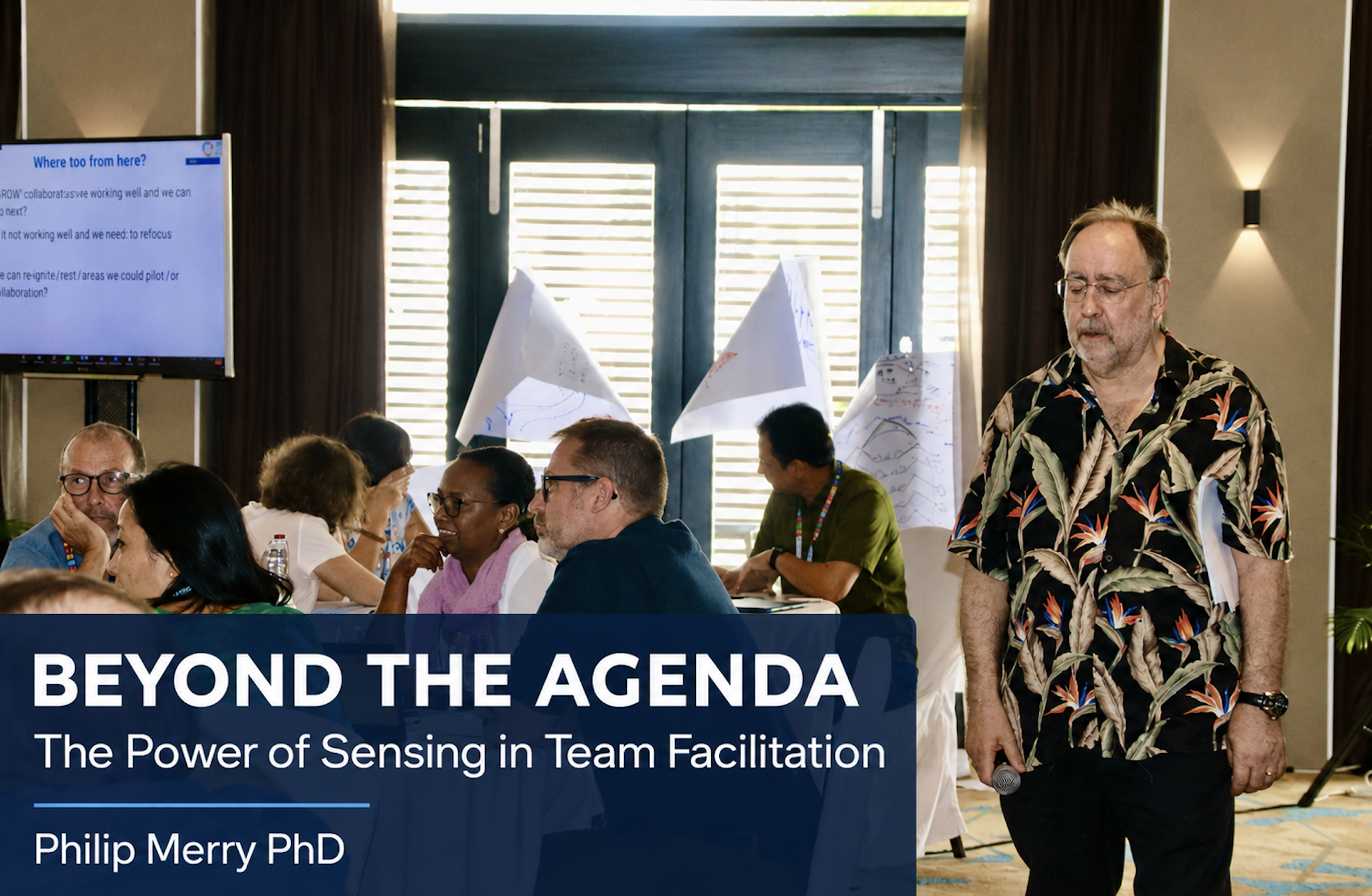
This photograph captures an important moment during a recent divisional team retreat I
recently facilitated.
The participants are working together at their tables. I have stepped aside, closed my eyes and
become still. I am not disengaged or taking a break. A recent issue that was not on the agenda
has just been raised, and I am sensing what to do.
I am listening beneath the words and activity to intuit what the team needs next.
Some might describe this as reading the room. I experience it at a deeper level—as sensing
the quantum field of information that surrounds and connects the group.
Facilitation Is More Than Following a Plan
Every effective team retreat needs a clear purpose, thoughtful design and well-chosen
activities. But a team is a living human system, not a machine that will automatically follow
the facilitator’s agenda.
1A facilitator may arrive with an excellent plan, yet something unexpected emerges:
• An uncomfortable silence follows an apparently innocent question.
• One voice begins to dominate.
• Energy suddenly disappears from the room.
• A conversation moves away from the agenda to what truly matters.
• Participants become animated around an issue that had seemed unimportant.
• A disagreement reveals the real challenge facing the team.
At these moments, facilitators have a choice. We can force the group back onto the
predetermined agenda—or pause, sense what is happening and respond to what the team
actually needs.
The most important intervention is not always the one written in the facilitator’s guide.
What Does It Mean to Sense a Team?
Sensing involves paying attention to several levels of information simultaneously.
We listen to what people are saying, but also notice what they are not saying. We observe
body language, tone of voice, participation patterns, emotional shifts and changes in the
energy of the room.
But sensing goes beyond observation.
It means quietening our own internal chatter and becoming receptive to intuition: the subtle
inner knowing that may indicate it is time to ask a different question, invite another voice,
remain silent, challenge the group—or completely change direction.
Sometimes I will suddenly know that the planned activity is no longer appropriate. At other
times, a question arises in my mind that I had not prepared for. When I trust that intuition and
ask it, the conversation often moves to the heart of the matter.
This does not mean abandoning experience, evidence or professional judgement. Intuition
works alongside them. Decades of facilitation create a deep reservoir of pattern recognition—
but there are also moments when we access information through the collective field itself.
From Reading the Room to Sensing the Field
Teams generate more than individual opinions. As people interact, they create a collective
emotional and informational field.
When a team develops greater coherence—when people become more present, connected and
open—new insights often emerge. Connections appear. The right question arises. Previously
separate ideas suddenly form a meaningful whole.
This is where collective intelligence becomes visible.
2TeamSynchronicity ® is the capability of a team to intuitively access a deeper field of
collective intelligence, through coherence and synchronicity, that delivers results.
The facilitator’s role is not to manufacture this intelligence. It is to help create the conditions
in which the team can access it.
Sensing Requires Inner Stillness
Facilitators cannot clearly sense a team if they are preoccupied with proving their
expertise, completing every slide, or worrying about what to say next.
We need moments of stillness.
In the moment captured in this photograph, closing my eyes helped me briefly withdraw from
the visible activity and connect with a deeper level of awareness.
I was listening inwardly while remaining connected to the group.
A skilled facilitator moves continually between action and receptivity:
• guiding and listening;
• speaking and remaining silent;
• following the design and responding to emergence;
• analysing what is happening and intuiting what wants to happen next.
This is not passive facilitation. It is disciplined presence.
Intuition Must Be Held with Humility
Sensing does not make a facilitator infallible. What feels like intuition can sometimes be
personal preference, anxiety or projection.
That is why intuition should be treated as information to explore—not as
unquestionable truth.
Rather than declaring, “I know what is happening in this team,” a facilitator might say:
“I sense that there may be something important we have not yet discussed. Does that resonate
with you?”
This gives the insight back to the team for verification. The facilitator offers a possibility
while allowing participants to confirm, reject or reshape it.
The purpose is not to display mysterious powers. It is to serve the team.
The Facilitator as Instrument
Methods and models matter.
3But the facilitator’s most important instrument is ultimately the facilitator.
Our presence, self-awareness, emotional sensitivity, cultural awareness and capacity for
intuition influence what we notice and how we intervene.
After more than four decades of facilitating teams across 63 countries, I have learned that
some of the most transformational moments cannot be scheduled. They emerge when we
are sufficiently present to notice them—and courageous enough to follow them.
The question for facilitators is therefore not only:
“What should I do next?”
It is also:
“What is this team asking for now—and am I quiet enough to sense it?”
Facilitation Mastery is not simply the ability to lead a team through an agenda.
It is the ability to be still and sense when the team’s deeper intelligence is beginning to
speak—and to help the team listen.
Philip Merry PhD 29th August 2026
“Helping Teams Flourish, Uncover their Collective Intelligence &
Deliver Extraordinary Results”
Bibliography
Dane, E., & Pratt, M. G. (2007). Exploring intuition and its role in managerial decision-
making. Academy of Management Review, 32(1), 33–
54. https://doi.org/10.5465/AMR.2007.23463682
Edmondson, A. C. (1999). Psychological safety and learning behaviour in work
teams. Administrative Science Quarterly, 44(2), 350–383. https://doi.org/10.2307/2666999
Jaworski, J. (1996). Synchronicity: The inner path of leadership. Berrett-Koehler.
Jung, C. G. (1973). Synchronicity: An acausal connecting principle. Princeton University
Press. (Original work published 1952)
Merry, P. (2017). Synchronicity and leadership [Doctoral dissertation, Tilburg
University]. Tilburg University Research Portal
Merry, P. (2022). The 9 keys of synchronicity: Open the doors to possibilities that are all
around you, hidden in plain view. Philip Merry Consulting Group.
4Merry, P. (2026, January 9). Toward a theory of team synchronicity: A qualitative study of
behaviours, facilitation practices, and quantum leadership qualities. Facilitators Network
Singapore. Read the article
Scharmer, C. O. (2009). Theory U: Leading from the future as it emerges. Berrett-Koehler.
Senge, P. M., Scharmer, C. O., Jaworski, J., & Flowers, B. S. (2004). Presence: Human
purpose and the field of the future. Society for Organizational Learning.
Wheatley, M. J. (2006). Leadership and the new science: Discovering order in a chaotic
world (3rd ed.). Berrett-Koehle