
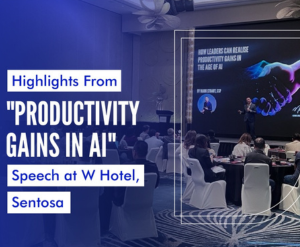
When Mark Stuart, CSP delivered his keynote, How Leaders Can Realise Productivity Gains in the Age of AI, at W Hotel Sentosa Cove in Singapore for Allianz on 10 April 2026, the audience was a senior and C-suite audience of insurance leaders — people responsible for strategy, performance, risk, transformation, clients, and the future relevance of their organisations.
The real AI question for leaders today is no longer, “What can the technology do?” The more urgent question is, “How do we convert what the technology can do into measurable business value?”
The real AI question for leaders today is no longer, “What can the technology do?” The more urgent question is, “How do we convert what the technology can do into measurable business value?”

Yet the paradox is clear: while AI can create impressive gains at the task level, many organisations are still struggling to translate those gains into enterprise-wide productivity. This was one of the central themes of the keynote. As highlighted in the Allianz presentation slides, AI can deliver task-level gains of 14 to 55 per cent, yet many companies are still not seeing meaningful productivity improvements across the organisation. This is the leadership challenge of the AI age.
AI Is Not Just an Efficiency Tool
For many organisations, the first instinct is to treat AI as a faster way to do existing work. Draft the report faster. Summarise the meeting faster. Generate the email faster. Analyse the data faster. While these are useful improvements, they are not transformation.
The keynote made a crucial point: productivity gains only become valuable when saved time is reinvested into better outcomes. If a broker saves three hours preparing a client proposal, but the proposal is merely completed earlier rather than made sharper, more personalised, more persuasive, or more commercially valuable, then the organisation has saved time without creating strategic advantage.
This is where many AI initiatives stall. Employees become more efficient, but the company does not become more competitive.
Research supports this tension. MIT Sloan reported that generative AI improved the performance of highly skilled workers by nearly 40 per cent in certain professional tasks. (MIT Sloan) But organisational gains do not automatically follow individual gains. McKinsey’s 2025 State of AI research found that for most organisations, AI had not yet significantly affected enterprise-wide EBIT, with many reporting only limited bottom-line impact. (McKinsey & Company)
AI can help individuals work faster. But leaders must redesign the system so that faster work becomes better work.
In other words, AI can help individuals work faster. But leaders must redesign the system so that faster work becomes better work.
Insurance is built on trust, risk, judgement, data, relationships, and speed. These are exactly the areas being reshaped by AI. Client expectations are changing rapidly. Customers and corporate clients are increasingly used to instant responses, personalised experiences, predictive recommendations, and seamless digital service. At the same time, competitive pressure is forcing insurers, brokers, and advisory firms to reduce costs while improving service quality.

In insurance, this is not theoretical. Accenture has noted that generative AI can reduce claims cycle time from days to minutes in suitable claims processes. (Insurance Blog | Accenture) McKinsey’s earlier work on the future of insurance suggested that many claims resolutions could eventually be measured in minutes rather than days or weeks. (McKinsey & Company) For leaders, the implication is profound. Insurance professionals will not simply be asked to work faster. They will be asked to work differently.
From Task Productivity to Enterprise Productivity
One of the most important distinctions in the keynote was the gap between task productivity and enterprise productivity.
Task productivity is when an employee uses AI to complete a specific activity faster. Enterprise productivity is when the organisation redesigns workflows, decision rights, governance, performance standards, and talent development so that the entire business creates more value.
The keynote challenged leaders with a practical discussion question: where is time being saved, but value is not increasing?
That is why the keynote challenged leaders with a practical discussion question: where is time being saved, but value is not increasing?
This is a powerful question for any senior leadership team. For example, if AI reduces proposal drafting time by 50 per cent, what happens next? Do advisers spend the saved time strengthening client relationships? Do they build more customised risk insights? Do they develop better cross-selling opportunities? Do they increase the number of high-quality client conversations? Or does the time simply disappear into more meetings, more emails, and more internal administration?
The difference is leadership design.
This connects closely with McKinsey’s finding that organisations are more likely to see bottom-line impact when they redesign workflows as they deploy generative AI, rather than simply layering AI tools on top of existing processes. (McKinsey & Company)
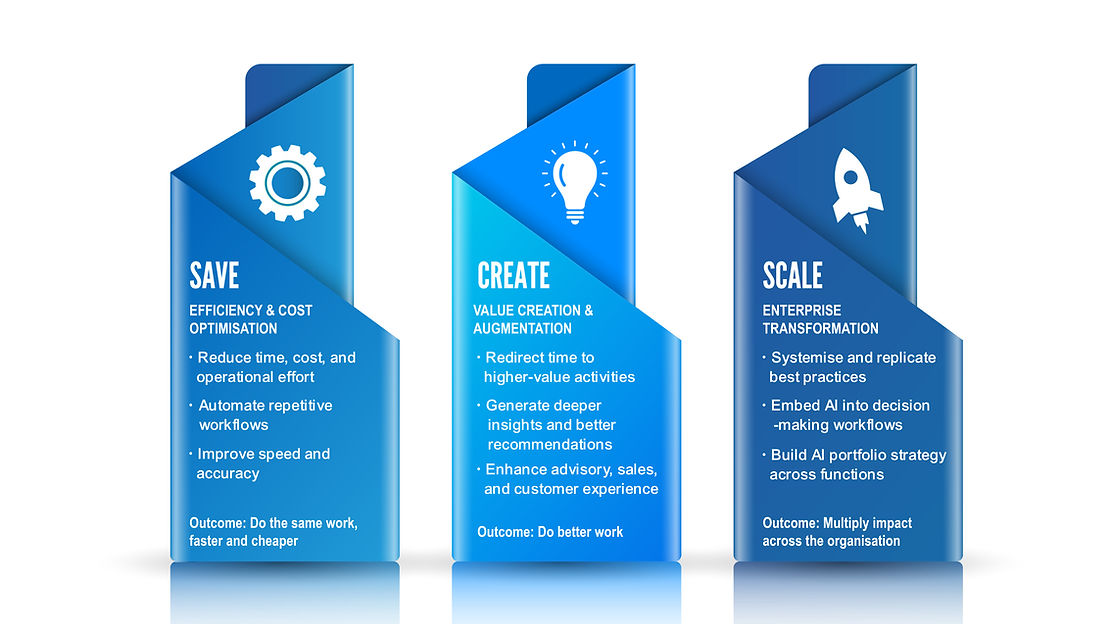
Second, AI can help organisations “create” by increasing value. This means redirecting time towards higher-value activities such as client advisory, insight generation, product innovation, stronger risk recommendations, and better employee development.
Third, AI can help organisations “scale” by embedding successful use cases across the enterprise. This requires systems, governance, training, adoption, and leadership alignment.
Many companies stop at “save”. They use AI to reduce effort, but they do not move deliberately into “create” and “scale”. That is why the productivity promise of AI remains under-realised. The strategic opportunity is not simply to do the same work with fewer people. It is to use AI to elevate the quality, reach, and impact of human work.
The Four Leadership Shifts Required
The keynote outlined four leadership shifts required in the age of AI.

This is especially relevant in insurance, where many workflows still carry the weight of legacy systems, regulatory processes, manual checks, and fragmented data. AI adoption cannot be treated as a plug-in. It must be part of operating model redesign.
The third shift is to lead human and AI teams.
The fourth shift is to manage risk versus speed.
In regulated industries such as insurance and finance, speed without governance is dangerous. But excessive caution can also create competitive disadvantage. Leaders must build the discipline to move quickly where appropriate, while maintaining compliance, accountability, transparency, and trust.
The keynote also addressed why many finance and insurance companies struggle with AI implementation. The reasons are familiar to many senior leaders: legacy systems, integration challenges, data quality issues, capability gaps, ethical concerns, regulatory uncertainty, model bias, lack of transparency, poor leadership alignment, and cultural resistance.
These are not minor obstacles. Insurance companies often operate across complex product lines, jurisdictions, client segments, regulatory frameworks, and distribution channels. Even when AI use cases are compelling, implementation can be slowed by fragmented data, unclear ownership, compliance concerns, and fear among employees.
AI transformation cannot be delegated entirely to the technology function. It must be owned by the business.
This is why leadership is so central. AI transformation cannot be delegated entirely to the technology function. It must be owned by the business.
Senior leaders do not need to become technical experts, but they do need digital ambition. They need to understand enough to ask better questions, challenge assumptions, allocate resources wisely, and create the conditions for responsible experimentation.
The Future of Broking and Advisory
The future adviser will not be valuable simply because they have access to information. AI will make information more abundant and more accessible. The future adviser will be valuable because they can interpret information, exercise judgement, build trust, understand context, manage uncertainty, and guide clients through complex decisions.
The Allianz keynote framed this future around three ideas: system-enabled performance, interpreters of information, and AI-backed risk advisers.
This is a powerful direction for the insurance industry. AI can support advisers by reducing administrative load and increasing insight. But the human advantage remains critical: empathy, curiosity, creativity, relationship-building, ethical judgement, and the ability to understand what a client is not saying.
For business leaders in Asia, this is especially relevant. In many Asian markets, trust and long-term relationships remain central to business development. AI may help advisers become faster and more informed, but trust will still be built human to human.
The Human Advantage in an AI World

This is not a soft issue. It is a strategic issue. If employees see AI as a threat, adoption will be slow, defensive, or superficial. If they see it as a tool that helps them become more capable, more strategic, and more valuable, adoption becomes more energised.
Leaders must therefore communicate AI as a capability shift, not merely a cost-reduction exercise.
Leaders must therefore communicate AI as a capability shift, not merely a cost-reduction exercise. They need to help employees understand how their roles may evolve, what skills they need to build, and how AI can help them do more meaningful work.
The best organisations will not simply train employees to use AI tools. They will develop AI-ready judgement. They will teach people how to ask better questions, validate outputs, spot risks, protect client trust, and apply domain expertise more effectively.
This is particularly important in insurance, where poor judgement can create real consequences for clients, regulators, and the business.
Governance, Ethics and Risk
AI governance should define who is accountable for AI use, how tools are approved, how data is protected, how outputs are validated, and how risks such as bias, hallucination, privacy breaches, and poor decision-making are managed.
Reuters has reported that while AI is valuable in insurance pricing, underwriting, and administrative analysis, industry experts have warned that entirely removing the human from underwriting has had limited success, and that deepfakes and AI-enabled fraud create new risks. (Reuters)
This is why the winning model is not “AI instead of humans”. It is “AI with accountable humans”.
The leadership responsibility is to create a system where speed and safety reinforce each other. That requires clear policies, strong governance, continuous learning, and a culture where people are encouraged to use AI responsibly rather than secretly or carelessly.
Learning from Banking and Other Industries
The keynote also drew on banking examples to show how AI can produce real operational impact. Klarna’s AI assistant, for example, handled 2.3 million customer conversations in its first month, equivalent to the work of 700 full-time agents, while maintaining customer satisfaction scores comparable with human agents. It also reduced repeat inquiries by 25 per cent and cut average resolution time from 11 minutes to under two minutes. (klarna.com)
These examples are important because they show what happens when AI is not merely used as a chatbot, but integrated into real customer workflows with clear authority, measurement, and operating model implications.
However, leaders should not copy such examples blindly. Insurance, banking, healthcare, logistics, and professional services all have different risk profiles, client expectations, and regulatory realities. The better question is: what can we learn from these examples about workflow redesign, leadership courage, measurement, and scaling?
The Takeaways for Senior Leaders

First, identify where GenAI advancement is happening in your industry, then spot opportunities for scalable enterprise adoption. AI experimentation is useful, but random experimentation rarely transforms the business.
Second, recognise that AI can increase task productivity without increasing value. Leaders must redesign work so that time saved becomes revenue growth, client impact, better risk management, or improved employee capability.
Third, understand how AI can transform the organisation’s work and the talent skills required. This means developing more strategic risk advisers, stronger data-literate leaders, and teams capable of working confidently with AI.
Ultimately, the companies that win in the age of AI will not be those that buy the most tools. They will be those that ask better leadership questions.
Ultimately, the companies that win in the age of AI will not be those that buy the most tools. They will be those that ask better leadership questions.
-
Where are we saving time but not creating value?
-
Where are we using AI to accelerate yesterday’s processes instead of designing tomorrow’s work?
-
Where do humans need to remain firmly in the loop?
-
Where can AI help our people become more strategic, more client-focused, and more commercially effective?
Conclusion: Productivity Is a Leadership Outcome
These themes align closely with the evolving demands on leaders today and the broader shifts shaping the future of work in Singapore. If you are looking for a keynote speaker in Singapore who can address leadership, innovation, and the future of work in a practical and engaging way, learn more about Mark.